50/30/20 Rule: The Budgeting Framework Every Woman Needs to Know
Let me ask you something.
Do you know where your money went last month? Not roughly — but actually?
If the answer is "not really," you're in good company. Most of the women I speak to — smart, successful, internationally mobile women — have a vague sense of their spending but no real system behind it. They save when there's something left over. They invest when they "feel ready." And they quietly wonder why their bank balance doesn't reflect how hard they work.
Here's what I've learned after 15+ years in wealth management: it's rarely about how much you earn. It's about where it goes.
That's where the 50/30/20 rule comes in.
What Is the 50/30/20 Rule?
It's one of the simplest, most powerful budgeting frameworks ever created — and it's the foundation I recommend to every woman who is serious about building wealth without turning budgeting into a second job.
Here's how it works:
You divide your after-tax income into three buckets:
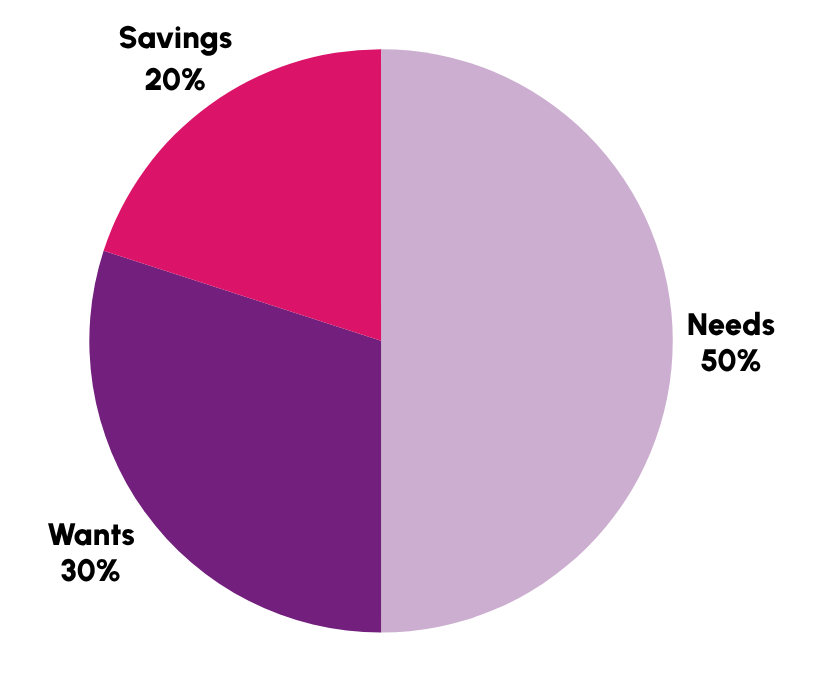
What I love about this framework — and why I recommend it to every woman who walks through my door — is that it doesn't ask you to be perfect. It asks you to be intentional. And that small shift? It changes everything.
Let's Break It Down
🏠 50% — Needs
These are the non-negotiables. The expenses that, if you removed them, your life would fall apart:
Rent or mortgage
Groceries
Utilities — electricity, gas, water
Phone and internet — the essentials of modern life
Health insurance
Transportation to work
Minimum debt repayments
One thing I want to be clear about: fix costs are not the same as comfortable costs. That streaming subscription you forgot you had? Probably lifestyle. The gym you've been paying for but haven't visited in three months? Definitely lifestyle. This bucket is reserved for the things that would genuinely disrupt your life if they disappeared overnight.
A useful exercise: go through your last bank statement and highlight everything that recurs automatically. That's usually a solid first draft of your fix costs. Then ask yourself honestly — does this belong here, or is it actually a choice?
🛍️ 30% — Wants
Here's where most budgets fail: they try to eliminate joy. The 50/30/20 rule doesn't.
Your wants are the things that make life yours:
Dining out and coffee dates — yes, these count and they're allowed
Travel and weekend trips
Shopping and beauty
Streaming services
Hobbies, experiences and education
This bucket is guilt-free. You've already paid yourself first (more on that in a moment). This is your permission slip to enjoy your money without sabotaging your future.
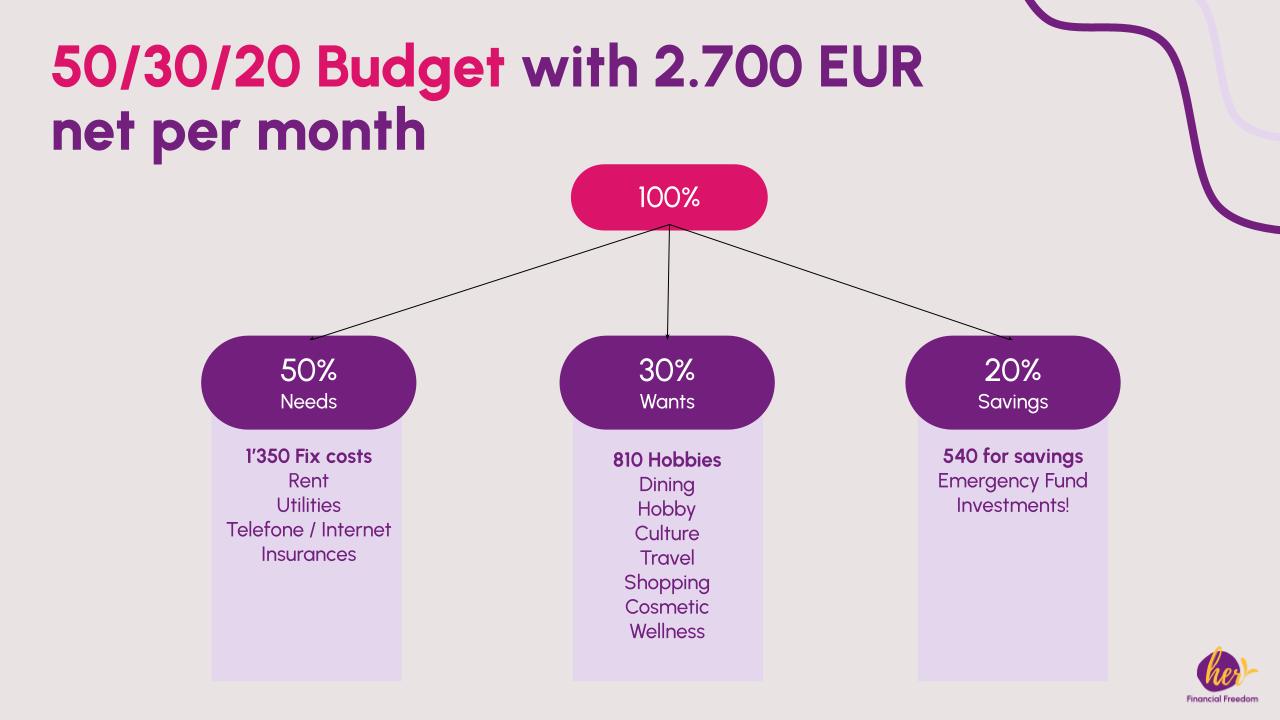
The key word here is intentional. You're not spending freely — you're spending within a defined limit that you've chosen. If you know you have EUR 810 for lifestyle this month, you get to decide how to use it. Maybe you skip the shopping trip and put it toward a weekend away instead. That's the point — you're in charge of every euro.
💰 20% — Savings & Investments
This is the bucket that changes your future — and it's the one most women either skip, underfund, or fill with a savings account earning 0.1% interest.
Your 20% should be working for you. That means:
Emergency fund (3–6 months of living expenses, liquid)
Retirement savings (pension contributions, pillar 3a if you're in Switzerland)
Investments (a portfolio that grows while you sleep — not cash sitting idle)
This is the bucket that separates the woman who works hard her whole life from the woman who builds genuine, lasting freedom.
Let's Make It Real: The EUR 2,700 Scenario
Numbers on paper are one thing. Let's see what this actually looks like.
Say your monthly after-tax income is EUR 2,700 — a realistic salary for many internationally mobile women, especially earlier in their career or when navigating a new country.
Here's how the 50/30/20 rule breaks it down:
What If the Numbers Don't Fit? (Real Adjustments for Real Life)
I want to be honest with you: for some women, the 50/30/20 split won't land perfectly on day one. And that's okay. Here's how to adapt without abandoning it.
"My rent alone is more than 50% of my income."
This is extremely common in cities like Zurich, Geneva, Munich, or Amsterdam. If your fix costs genuinely can't go below 60%, compress your lifestyle bucket first — not your savings. Moving to 60/20/20 or even 65/15/20 is still a massive improvement over having no system at all. The 20% savings is the last thing you touch.
"I have debt that costs me more than investing would earn."
High-interest debt — credit cards, personal loans above 5–6% — should be treated as a priority within your savings bucket. Paying it down aggressively is a guaranteed return equal to the interest rate you're eliminating. Once it's gone, redirect every cent of those payments straight into investments.
"I'm in my 40s and I haven't started yet. Is 20% enough?"
Honestly? It might not be — and I'd rather tell you that than let you find out later. If you're starting later, consider pushing toward 25–30% during your peak earning years to close the gap. The compound growth curve is steepest in the early years, but starting now — even with a higher allocation — is infinitely better than waiting another decade.
How to Start Today (In Three Steps)
Step 1: Know your number.
Pull your last 3 months of bank statements. What did you actually spend — across categories? Most women are shocked by this number. That's normal. Don't judge it. Just see it.
Step 2: Assign the buckets.
Take your monthly after-tax income and calculate: 50% needs, 30% wants, 20% savings & investments. Where are the gaps?
Step 3: Automate the 20%.
The biggest mistake I see? Waiting to see what's left at the end of the month. There is never anything left. Set up an automatic transfer to your savings or investment account on the same day your salary lands. Pay yourself first — before the rent, before the groceries, before everything. That one habit is the single biggest predictor of long-term financial success I've seen in 15 years of working with women and their money.
The Bigger Picture
I've seen women go from zero investments to a CHF 90,000 portfolio in 15 months. I've seen women realize they could retire at 48 — not because they suddenly earned more, but because they finally had a system.
The 50/30/20 rule won't do the whole work. But it is often the first clear, confident step.
And here's what every client tells me, without fail: "I wish I had started sooner."
So don't wait until you feel ready. Don't wait until the timing is perfect. Don't wait until the numbers feel big enough.
Start now. Start small. Start with clarity.
Your future self is waiting.

Click here to subscribe for FREE: https://herfinancialfreedom.net/newsletter-blog


