Emergency Funds: Why You Need One and How to Build It (Without Punishing Yourself)
There is a moment most women know well: something unexpected hits—a car repair, a surprise medical bill, a job that suddenly disappears—and instead of handling it calmly, panic sets in. Not because you are bad with money. But because there was no cushion ready.
That cushion has a name. It's called an emergency fund, and it might be the single most powerful financial move you make before anything else.
What an Emergency Fund Actually Is
An emergency fund is a separate pot of cash you keep only for real, unexpected emergencies. Job loss, urgent medical costs, a broken boiler in winter, an emergency flight home.
It is not for flights you forgot to save for, a sale that feels too good to miss, or a weekend away because work has been stressful. Those are lifestyle choices, not emergencies—and mixing them up is exactly how the cushion disappears.
Think of it as the financial equivalent of a seatbelt. You hope you never need it. But you would never drive without one.
Why You Need One (Especially as a Woman)
Without an emergency fund, one bad week can spiral into months of high-interest debt. A car repair goes on a credit card. The credit card balance grows. You start the next month already behind.
But there is a deeper reason this matters for women specifically. Financial independence is not just about investing—it is about options. An emergency fund is what allows you to say no to a job that is making you miserable, leave a situation that no longer serves you, or make a brave decision without the weight of financial panic.
It also protects your investments. When markets drop and life gets expensive at the same time, the women who stay invested are the ones who had cash set aside for emergencies. Everyone else sells at the worst moment—not because they wanted to, but because they had no choice.
How Much Is "Enough"?
The honest answer is: it depends on your life. But here is a simple framework to work with:
1 month of essential expenses is your starter goal—the minimum that creates a real buffer.
3–6 months is the standard recommendation for someone with a stable job and no dependents.
6–12 months makes sense if you are self-employed, have irregular income, support others, or live abroad without a strong local safety net.
"Essential expenses" means the bare minimum to keep your life running: rent or mortgage, food, utilities, insurance, transport, minimum debt payments. Not your full lifestyle—just the version that keeps you safe and functional.
Start by calculating what one month costs you on that bare-bones basis. That is your first milestone.
How to Build It Step by Step
1. Know your number.
Take your monthly essential expenses and multiply by 3 (or 6 if you need more security). That is your target. Write it down. Make it real.
2. Give it its own home.
Open a separate savings account—ideally one that earns some interest—and label it "Emergency Fund." Keeping it separate from your everyday account removes the temptation to dip in.
3. Start small and automate.
Choose a monthly transfer that feels genuinely manageable—CHF 100, CHF 300, whatever fits—and schedule it to move automatically right after payday. Automation removes the decision, and removed decisions get done.
4. Find the money without torturing yourself.
You don't need to cut everything to build this fund. Use your finance tracker to spot where money quietly leaks—unused subscriptions, habitual takeaways, impulsive small buys. Redirect one or two of those leaks into your emergency fund. Small redirects compound faster than you think.
5. Celebrate the milestones.
This is not glamorous saving. It feels slow and invisible. So mark every 25%—when you hit your first month saved, your second, your third. Acknowledge the progress out loud.
Where to Keep It (And Where Not To)
Your emergency fund's job is to be there when you need it—not to be clever.
Keep it in a High-Yield Savings Account (HYSA)—a regular savings account that pays significantly more interest than a standard bank account, without locking your money away. It stays accessible, grows quietly, and earns while it waits. Ideally keep it at a separate bank from your everyday account so a moment of weakness doesn't drain it.
Do not keep it in stocks or ETFs. Markets can fall exactly when life gets hard, and you do not want to be forced to sell investments at a loss just to cover an unexpected bill.
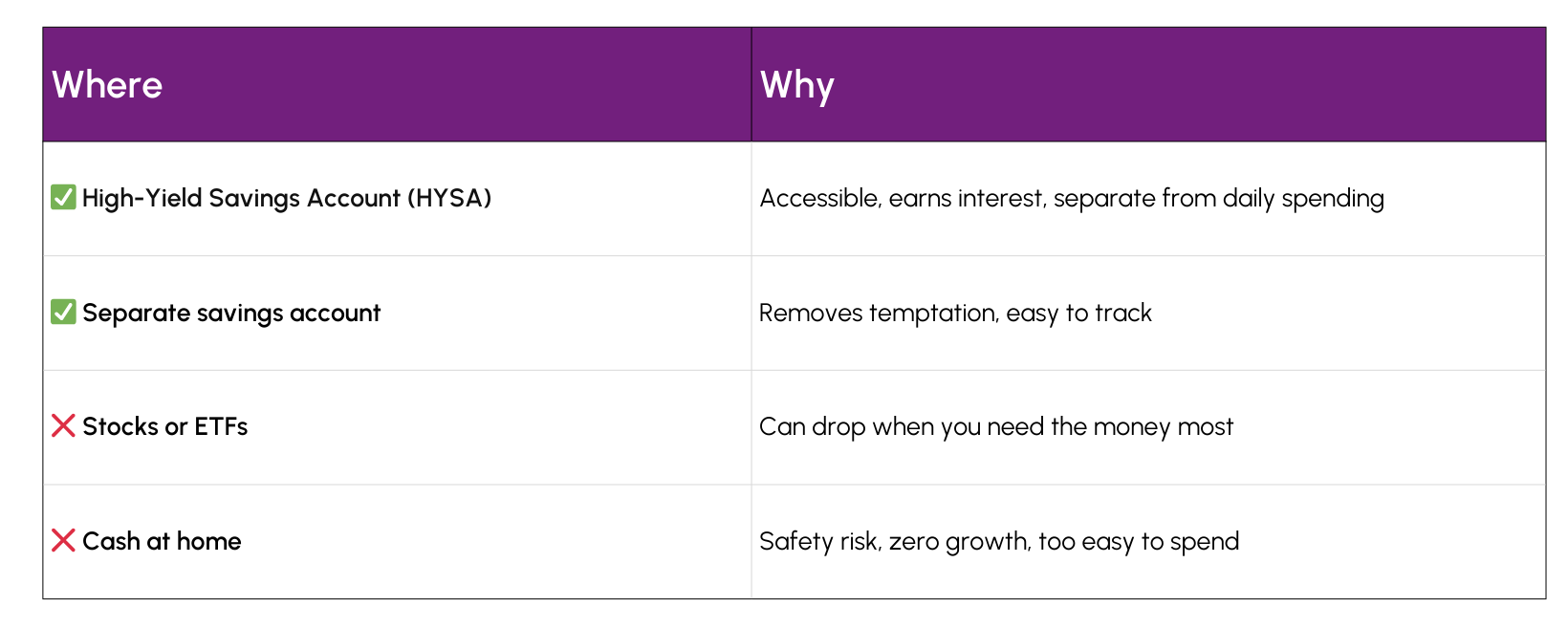
Simple rule: your emergency fund should be boring, accessible, and earning something.
When to Use It—and When Not To
Real emergencies (yes, use it): Job loss, unexpected medical costs, urgent home or car repair, emergency travel for family, essential equipment failure.
Not emergencies (do not use it): Sales, holidays you forgot to save for, a business idea, or an investment opportunity that "has to happen now."
And one important rule: if you use it, your next financial priority is to quietly refill it—without guilt, without punishment, just steadily back to your target.
How This Fits Into Your Bigger Plan
An emergency fund is not the end goal. It is the foundation everything else sits on.
When you have 3–6 months of cash set aside, you can invest with a calm mind—because you know a difficult month won't force you to sell. You can take career risks because you have a runway. You can stay in the market when headlines are loud because your daily life is protected.
Build the cushion first. Then build the future.
Ready to build yours? Start with one number: what does one month of essentials cost you? That's your first goal.

Click here to subscribe for FREE: https://herfinancialfreedom.net/newsletter-blog


