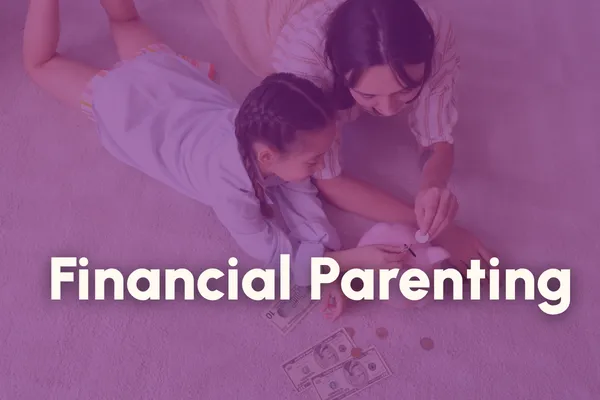
What Is Financial Parenting — And Why It Starts Earlier Than You Think
The average child forms their money beliefs and habits by the age of seven. Not seventeen. Not when they get their first job or open their first bank account. Seven. I didn't know that until I was well into my banking career, and when I found out, it stopped me in my tracks. Because it means the most important financial education most of us will ever receive happens before we even know what a bank is. And for most of us, it never happened at all.
Your child watches you check your bank account and visibly tense up. They don't know the numbers. But they feel the energy. Money = stress. That is a financial lesson, just not the one you meant to teach.
Financial parenting is not only what you say about money. It is everything your child absorbs about it, long before you ever sit down to explain it. And it starts much earlier than most people think.
What Financial Parenting Actually Means
Financial parenting is not about sitting your five-year-old down with a spreadsheet. It is not about turning family dinner into an economics lecture. And it is absolutely not about making children anxious about money.
It is about something far simpler: giving children a healthy, confident relationship with money before the world gives them a complicated one.
It is the conversations you have and the ones you don't avoid. It is the habits you model without realising it. It is the language you use around earning, spending, saving, and giving. It is whether money in your home is a source of shame, secrecy, and stress, or something you talk about openly and practically.
Ages 2–4: Plant the Seeds
I know what you are thinking. A two-year-old cannot invest. True. But a two-year-old can begin to understand that money is something real, that things cost something, and that you make choices about it.
At this age, financial parenting is entirely about exposure and language.
What this looks like in practice:
Let them see you handle money: At the supermarket, the market, the bakery, name what is happening. You are paying. This costs something. Here is the change. Small moments, repeated often, build a foundation.
Use a transparent piggy bank so they can actually see coins accumulatin:. The visual of money growing is surprisingly powerful even for a toddler.
Introduce the concept of choice: "We can buy the apple or the biscuit, which one?" Tiny decisions, but they begin to build the understanding that money involves choosing.
Avoid phrases like "we can't afford that" in a stressed, shameful tone: Instead, try "that's not something we're spending money on today"; a choice, not a crisis.
The goal at this age is not knowledge. It is emotional safety around money. Children who grow up hearing money discussed calmly, rather than in hushed, anxious tones, develop a fundamentally different relationship with it.
Ages 5–8: Make It Real
By now, children can understand basic concepts: earning, saving, spending, and giving. This is the age to introduce structure — gently, playfully, and consistently.
What this looks like in practice:
Introduce pocket money: even a small amount. The amount matters less than the regularity and the autonomy. Let them decide how to spend part of it. Resist the urge to override their choices. A child who blows their pocket money on something disappointing learns more from that experience than from any lecture.
Use three jars or envelopes: one for spending, one for saving, one for giving. This is the simplest version of budgeting, and it works because it is physical and visible.
Take them shopping with intention. Show them a price. Ask them: "If you had CHF 10, would you buy this?" Let them compare. Let them question. Let them be part of real-world decisions.
Talk about work and earning: Not in a heavy way, but help them understand that money comes from effort. "I go to work to earn money, and then we use that money for our home, our food, and our trips."
Introduce giving: Whether it is a charity they choose, a gift for a friend, or a contribution to something that matters to them, generosity is a financial habit, and it is never too early to cultivate it.
At this age, money is still a game. Keep it that way. The lessons land precisely because they do not feel like lessons.
Ages 9–12: Build the Concepts
This is the age when real financial literacy begins. Children at this stage can understand more abstract ideas: interest, budgeting, the difference between needs and wants, and the basics of how banks and money systems work.
They are also beginning to form their own identity around money, which means what they hear and see at home matters enormously.
What this looks like in practice:
Expand pocket money into a budget: At this age, consider giving them a larger amount that covers more, perhaps their own school snacks, small social outings, or clothing choices within a set amount. Responsibility expands with the money.
Introduce the concept of saving for a goal: Not just saving abstractly, but saving for something specific. Help them work backwards: "This costs CHF 80. You save CHF 10 a week. That means 8 weeks." Suddenly maths has a point.
Talk about compound interest: You do not need to use that phrase. Open a savings account together or show them how to start with CHF 100. Then do something most parents never think to do: check it together after a year. Let them see the interest that appeared without them doing anything. That moment of "wait, it grew?" is worth more than any explanation you could give.
Let them make bigger mistakes with smaller amounts: A pre-teen who overspends their monthly budget and has to wait until next month is learning one of the most valuable financial lessons available. Let it happen.
Ages 13–18: Build the Foundation
Teenagers are often more capable of understanding real financial concepts than we give them credit for. By this stage, they are watching everything — how you handle money, how you talk about it, whether you are stressed or confident, whether it is a source of power or anxiety in your home.
This is the stage to have real conversations. And to start giving them real experiences.
What this looks like in practice:
Open a savings account with them: By this age, they are ready to manage their own day-to-day money independently. Walk them through how it works: how to check a balance, set up a transfer, and read a statement. Give them full ownership of it, including the responsibility for what happens if they overspend. These are skills that seem obvious to adults and are completely foreign to most teenagers.
Introduce investing: You do not need to open a brokerage account. But you can explain: "When you invest money, you are buying a small piece of a company. If the company grows, your money grows too." Show them what CHF 100 invested at 7% for 40 years becomes. Let the number land.
Talk about the gender wealth gap: For daughters especially, the system was not built equally. Women earn less, contribute less to pensions due to career breaks, live longer, and retire with significantly less. Knowing this at 15 is not frightening — it is empowering. It gives them a head start that the statistics show most women never get.
Encourage earning: Whether it is babysitting, tutoring, a part-time job, or selling something they have made, the experience of earning their own money, managing it, and making decisions with it is irreplaceable.
And most importantly: answer their questions without shame. If a teenager asks how much you earn, how much your mortgage is, or what happens to your money when you die, those are not intrusive questions. They are exactly the right questions. The fact that they are asking means you have done something right.
The Conversation Most Parents Are Avoiding
Most of us are not teaching our children about money, not because we do not care, but because we never learned ourselves. We are trying to give our children something nobody gave us. And that is hard. You cannot pass on financial confidence you do not yet have.
You do not need to be a financial expert to raise a financially confident child. You need to be willing to talk about money openly, model thoughtful decisions, and give your children real experiences, however small, with earning, saving, spending, and giving.
The women who come to me having the hardest time with their finances are almost always the ones who grew up in homes where money was never discussed. Not because their parents were irresponsible, but because money was treated as something complicated, private, and slightly shameful.
Your children are watching you right now. What they see, hear, and absorb around money will shape their financial future far more than any school lesson or savings account you open for them.
The best thing you can do for their financial future and for the next generation of women who will inherit this wealth gap or close it starts at your kitchen table.
A Place to Start
If you are not sure where to begin with your own financial foundation, the one you will eventually model for your children, our weekly newsletter is a good first step. Jargon-free, practical, and written for women who are ready to take their financial future seriously.

👉 Subscribe to the herFinancialFreedom newsletter here: https://herfinancialfreedom.net/pension-guide-newsletter
Because the most powerful financial lesson you can give your child is watching you take yours seriously.


