
How Does Your Pension Actually Work?
Somewhere along the way, most of us made the same easy assumption.
That someone else was handling our pension. The employer. The state. The bank. So we didn't look. We kept working, kept saving, and quietly trusted that the system was doing what it was supposed to do.
Until one day, a career move, a divorce, an inheritance, a birthday that ended in a zero — something made us look. And what we found was not always reassuring.
Let's walk through it together.
The Reality Check: Why the Pension Gap Is Real
Before we get into how pensions work, I want to give you a number.
According to the UBS International Pension Gap Index (2024), mandatory pensions alone will not cover a median-earning woman's accustomed lifestyle in almost every country studied. And the data across Europe confirms it: in 2024, the average gender pension gap across the EU was 24.5%, meaning women's pensions were roughly one quarter lower than men's. Across 27 European countries, including non-EU members, the average gap stands at 22%, which means women receive just EUR 78 in pension income for every EUR 100 received by men. The gap shows up everywhere. The size of it changes. The gap itself does not.
There are very specific reasons why women end up with less:
Career breaks for caregiving reduce the years you contribute to your pension
Part-time work means lower employer pension contributions, even when working part-time is not a choice but a necessity
Job changes and international relocations create pension fragments across systems, currencies, and countries that nobody helps you piece together
Default investment strategies in employer pensions are almost always conservative, designed to protect capital, not to grow it
Most women simply do not know they have a choice about how their pension money is invested
Here is the important thing: every single one of these is fixable. Once you know about it.
How Pension Money Actually Works
Let me explain the mechanics because once you understand how your pension money moves, it stops feeling like a black box.
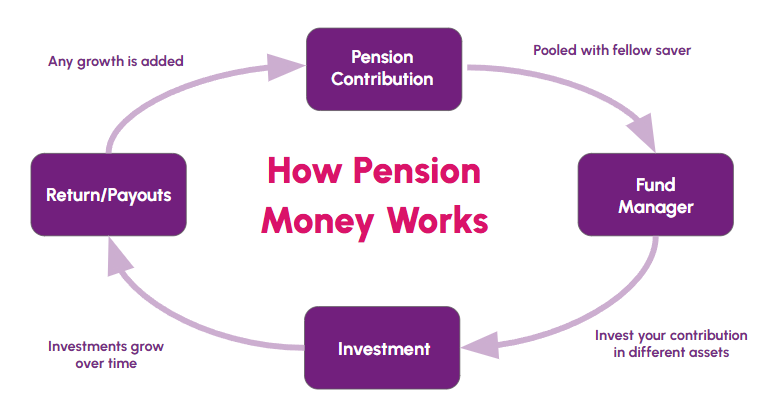
It starts with contributions. These are typically made by you, your employer, or both, often deducted directly from your salary before you ever see them. In some systems, the government also contributes or provides tax incentives to encourage you to save more.
Those contributions don't just sit there. They are pooled together with contributions from other savers and handed to professional fund managers, public pension entities, private banks, insurance companies, or corporate pension funds. Their job is to invest your money responsibly within strict regulatory guidelines, with the goal of generating returns while managing risk.
The money is then invested, typically in a diversified mix of shares, bonds, real estate, and other instruments. Some systems let you choose your own investment strategy. Others allocate automatically based on your age or risk profile. Many women have no idea which category they fall into.
Finally, when you reach retirement age, your pension begins to pay out as monthly income, a lump sum, an annuity, or a flexible drawdown, depending on the system and your plan.
The size of your payout depends on three things: how much was contributed, how well the investments performed, and what kind of plan you are in.
Which brings us to the most important structural question of all.
The 3 Pillars: The Universal Framework Behind Most Pension Systems
Whether you live in Switzerland, Luxembourg, Liechtenstein, Germany, or the United States, most pension systems in the world are built on the same three pillars. The names change. The mechanics shift. The underlying concept does not.
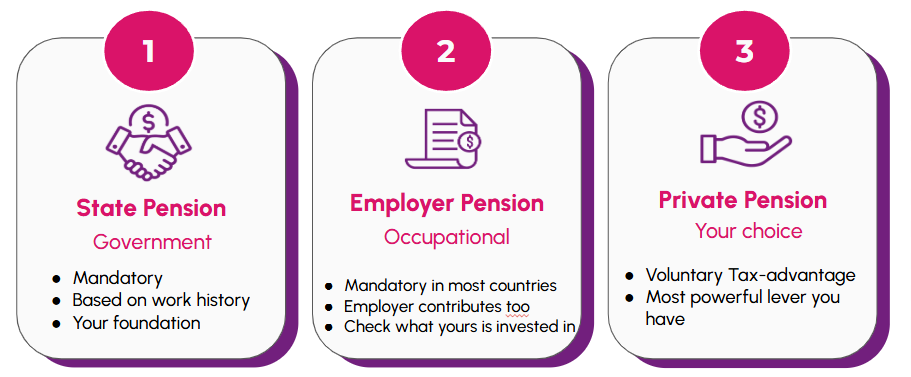
Pillar 1: State Pension (your foundation)
This is what your government "promises" you. It is designed to cover basic needs, not the lifestyle you are used to. It is based on years of contribution, which means career breaks, part-time work, and years spent in another country all shrink it.
Across most countries, Pillar 1 alone replaces far less than people expect. In the US, Social Security replaces around 43% of pre-retirement income for a medium-average earner and as little as 28% for high earners. According to the European Commission's 2024 Pension Adequacy Report, Luxembourg's average replacement rate in 2022 was 89%- 85% for men and 97% for women, well above the European average of 58%. In most systems, Pillar 1 was designed as a floor, not a full plan.
Pillar 2: Employer / Occupational Pension (mandatory in most countries)
This is the pension your employer sets up on your behalf. Both you and your employer typically contribute. In the US, this is your 401(k) or 403(b). In Switzerland, it is your BVG, mandatory for anyone earning above CHF 22,050 per year. In Liechtenstein, one of 15 occupational pension foundations manages your contributions, those foundations achieved an average return of 7.5% in 2024, the second-best investment year of the past decade. In Luxembourg, Pillar 2 is an optional supplementary employer plan, not all companies offer it, so whether you have it depends on your employer.
Here is the critical point most people miss: most employees are enrolled in a default investment fund, often a conservative one designed to protect capital, not grow it. You may not be able to change the strategy directly, but you absolutely can find out what it is, how it is invested, and what fees you are paying. That knowledge alone has the potential to change your outcome significantly.
Pillar 3: Private Pension (your most powerful lever)
This is the pension you build yourself. Nobody is going to remind you to do it.
But in most countries, the government gives you strong tax incentives to encourage it. In the US, a Roth IRA lets your investments grow tax-free with a 2025 maximum of USD 7,000 per year. In Switzerland, Pillar 3a contributions are fully tax-deductible up to the annual limit. In Luxembourg, private pension contributions of up to EUR 4,500 per year qualify for a tax deduction. Different countries, same principle: save privately, pay less tax now, grow more later.
Pillar 3 is where you decide how much you save, what it is invested in, and what kind of retirement you actually want. For most high-earning people, it is the deciding factor between "just enough" and "actually free."
Together, these three pillars form your retirement income. The pension gap is the difference between that combined income and what you actually need to live the life you want. Closing that gap is what long-term wealth strategy is really about.
What This Looks Like in Practice
The standard benchmark for retirement income is 80–90% of your current salary. Here is what the three pillars actually deliver for someone earning CHF 75,000 per year in Switzerland:
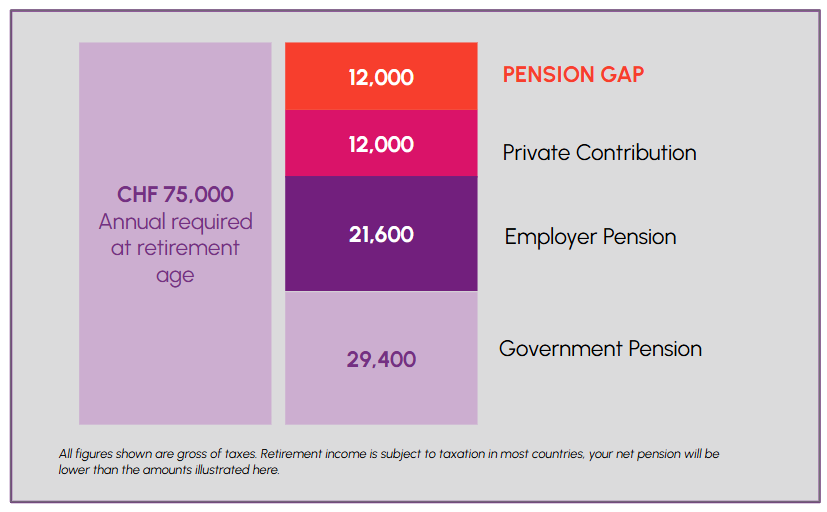
On a CHF 75,000 salary, the three pillars combined still leave a gap of CHF 12,000 every single year in retirement. For someone earning more, that gap grows significantly, because the government and employer pension are capped while your lifestyle is not.
This is why Pillar 3 is not optional for high earners. It is the only lever entirely in your hands.
If you want to see your own numbers, including worked examples for Switzerland, Luxembourg, Liechtenstein, and the US, they are all inside the free guide.
The Questions You Need to Ask Right Now
Wherever you are in the world, the five questions that matter are always the same:
How much do I actually have? Across all pillars and all countries.
Where is it held? Which provider, which fund, which pension authority.
What is it invested in? Asset allocation, risk profile, fund composition.
What is it costing me? Direct fees and indirect product fees, the Total Expense Ratio (TER) of every fund you hold.
Is there a gap and how do I close it?
Most women can answer one or two of these. Very few can answer all five. That is not a personal failing. It is a reflection of how poorly most pension systems communicate with the people they are supposed to serve.
Understanding your pension is not a one-afternoon project. But it does start with one question, and then the next one, and then the one after that.
If you want the full picture including how pensions work across Switzerland, Luxembourg, Liechtenstein, and the US, a step-by-step checklist for exactly what to do next, real examples of what the pension gap looks like in practice, and the common pitfalls to avoid — I have put it all together in one place.
👉 Download the free Pension Guide for Women here: https://herfinancialfreedom.net/pension-guide-blog
It is the guide I wish someone had handed me years ago. And it is yours, completely free.


