How Do Dividends Work and How Do You Get Paid?
Imagine you own a small piece of a company. That company has a great year, makes a profit, and then decides to share some of that profit with you. Just for owning the shares. No extra work required.
That's a dividend.
It sounds almost too simple. But this one mechanism, getting paid to own something, is quietly behind some of the most consistent wealth-building strategies I see in serious long-term portfolios.
Table of contents
3 Most Common Types of Dividends
Why Do Companies Pay Dividends?
Overview of the Main Methods of Dividend Payment
How to Buy Dividend-Paying Investments
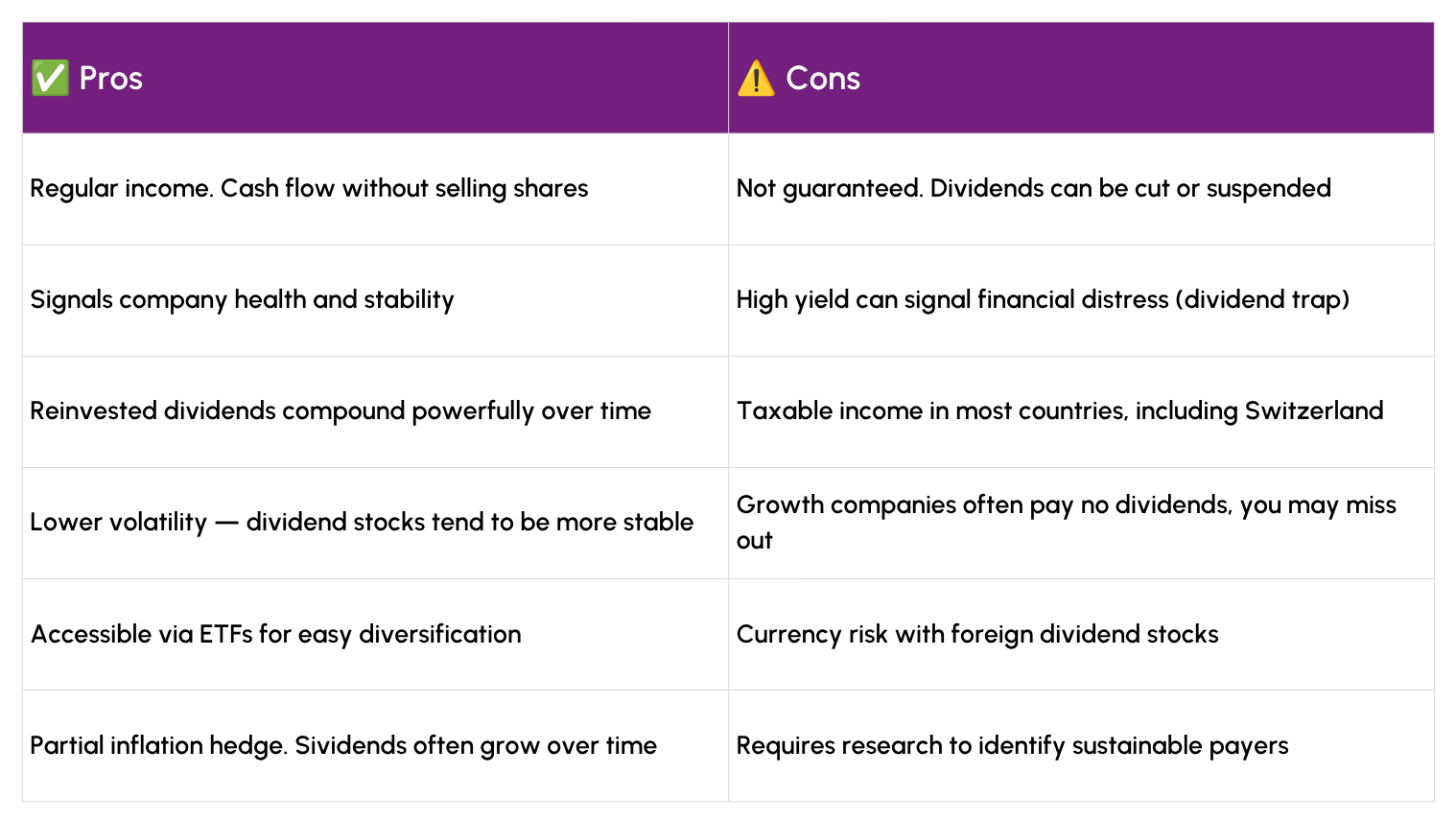
Pros and Cons of Investing in Dividend Stocks
What Are Dividends?
A dividend is a portion of a company's profits paid out to its shareholders, the people who own shares in that company.
Think of yourself as a silent business partner. You put money in, the business runs without you, you're not involved in the day-to-day, and when it makes a profit, you get your share. Proportional to what you own, automatically, just for being in.
The keyword is may. Not all companies pay dividends, and those that do can change or cut their dividend at any time. But for companies with a strong history of paying dividends, think Swiss blue-chip companies, European banks, consumer staples brands, dividends can form a steady, reliable stream of income on top of any growth in the share price.
How Dividends Work
Here's the basic process behind every dividend payment:
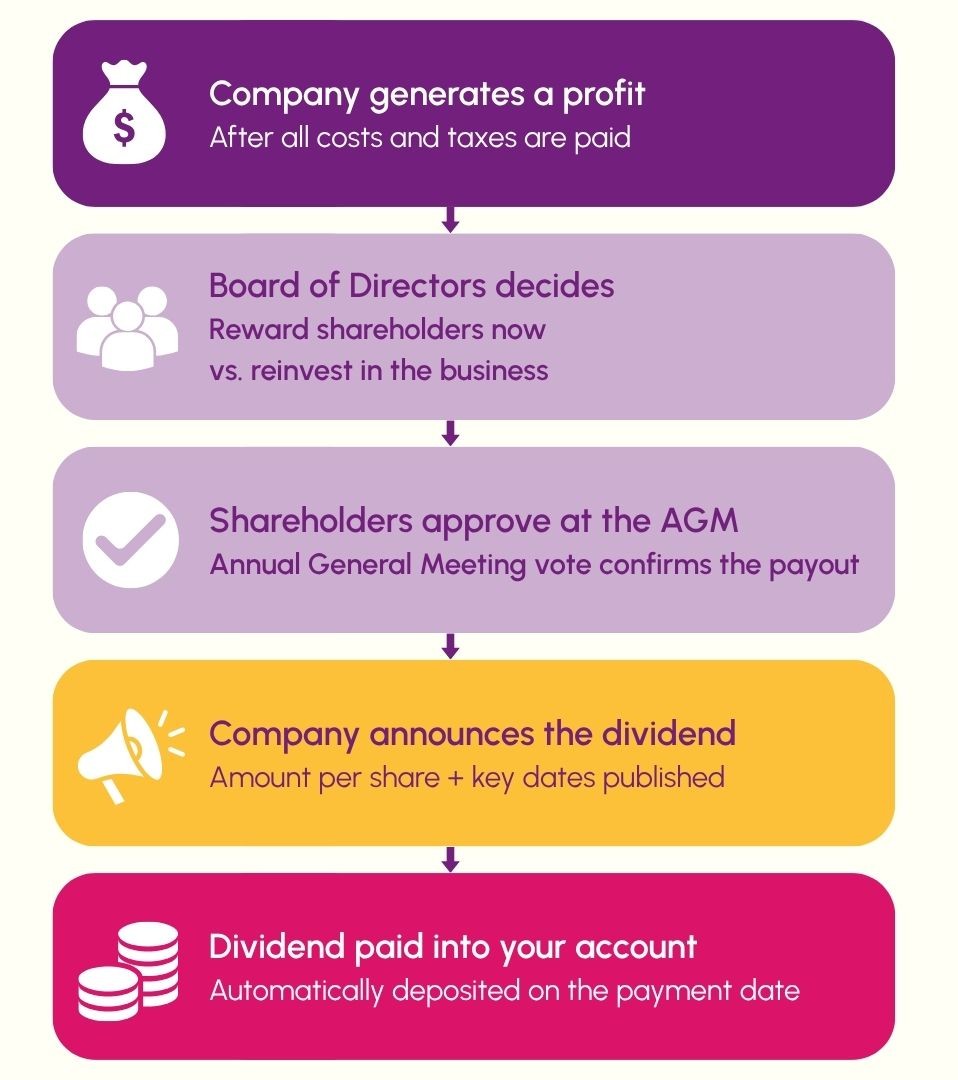
1. The company generates a profit.
After paying salaries, running costs, interest on debt, and taxes, what remains is called net profit or net income. This is the pool from which dividends are drawn.
2. The Board of Directors decides.
Not all profit becomes a dividend. The board weighs up how much to reinvest in the business, new equipment, expansion, research, versus how much to return to shareholders. The share paid out is called the payout ratio. A sustainable payout ratio typically sits between 30–60%. Much higher than that, and the company has little cushion left for difficult years.
3. Shareholders approve at the AGM.
The dividend proposal goes to a vote at the Annual General Meeting. Shareholders confirm the amount before anything is paid.
4. The company announces the dividend.
Once approved, the company publishes the dividend amount per share along with the key dates, including the all-important ex-dividend date, which determines who qualifies to receive the payment (more on dates below).
5. The dividend lands in your account.
No action needed on your part. If you owned the shares before the ex-dividend date, the payment arrives automatically on the payment date, directly into your brokerage account.
The amount you receive depends on how many shares you own. If a company pays a dividend of CHF 2.50 per share and you own 100 shares, you receive CHF 250. No buying or selling required.
3 Most Common Types of Dividends
Companies don't always pay dividends the same way. Here are the four types you're most likely to encounter:
Cash Dividends
This is what most people picture: money deposited directly into your account, proportional to the number of shares you hold. It's straightforward, liquid, and the preferred format for most income investors.
Stock Dividends
Instead of cash, the company issues you additional shares. Your stake in the company grows, but you don't receive cash. This is common when a company wants to reward shareholders while conserving cash, for example, one additional share for every 10 you already hold.
Special Dividends
A one-time, non-recurring payment, often after an exceptional year, a sale of a business division, or a significant cash windfall. Don't count on these repeating; they're bonuses, not promises.
Who Gets Dividends and How?
You receive a dividend if you own shares in a dividend-paying company before the ex-dividend date (explained in the next section).
Your dividend is typically:
Deposited as cash into your brokerage account (for cash dividends)
Added as new shares to your portfolio (for stock dividends)
Automatically reinvested if you've enrolled in a DRIP (Dividend Reinvestment Plan)
Important Dividend Dates
Dividend investing has its own calendar. These four dates matter:
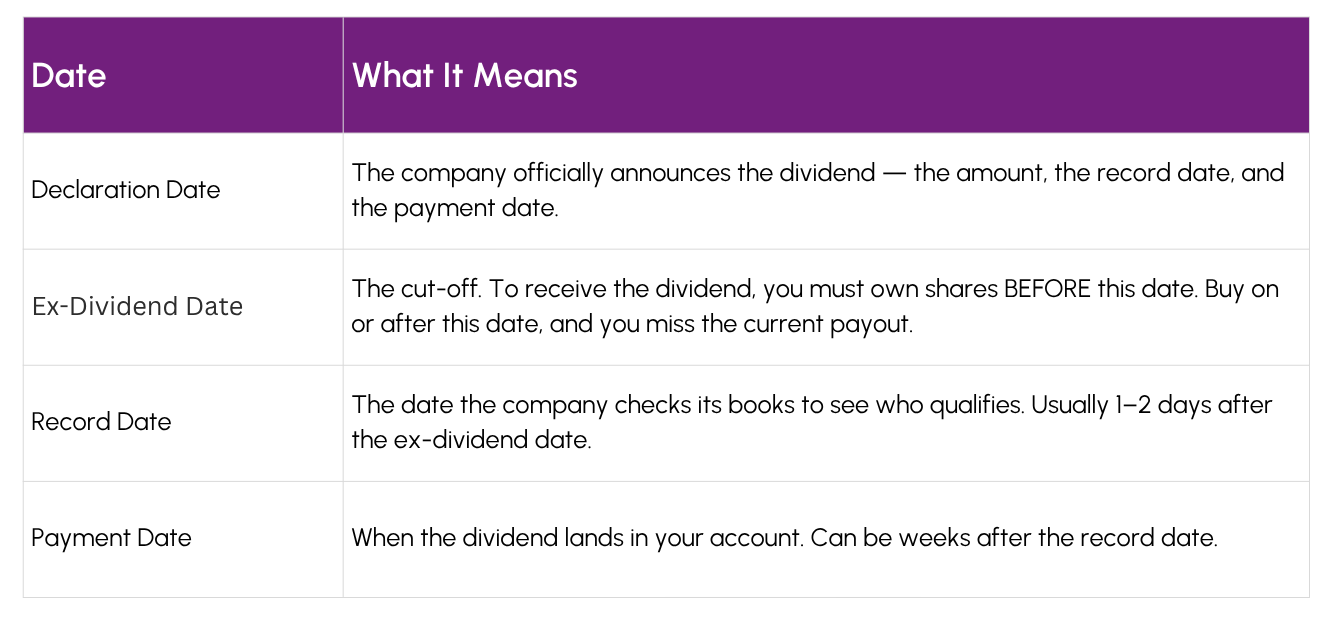
📌 The most important date to know as an investor: the ex-dividend date. If you want to receive the next dividend, you must own the shares before this date.
Why Do Companies Pay Dividends?
Signal of financial strength: Paying a consistent dividend tells investors: 'We are profitable, we are stable, and we can afford to share our success.' It builds trust.
Attract and retain investors: Many investors, particularly retirees and income investors, specifically seek dividend-paying stocks. Regular payments make shares more attractive.
Capital discipline: Returning excess cash to shareholders instead of sitting on it (or making poor acquisitions) is a sign of good management.
Competitive appeal: In a crowded market, a reliable dividend can differentiate one company's shares from a competitor's.
Companies that can't sustain high growth anymore, think mature utilities, consumer staples, banks, insurance companies, often redirect profits into dividends rather than expansion. This is why dividend stocks tend to be in 'boring' but stable industries.
Overview of the Main Methods of Dividend Payment
Zooming out, here's how dividend payments typically arrive depending on the investment type:
Cash to brokerage account: The most common method. The dividend lands directly as cash in your investment account on the payment date.
DRIP (Dividend Reinvestment Plan): Dividends are automatically used to purchase additional shares or ETF units instead of being paid out in cash. Powerful for compounding.
Stock dividend (scrip): Additional shares were issued to you instead of cash. Your percentage ownership stays the same; the company retains its cash.
Property / in-kind dividend: Very rare. The company distributes physical assets or products to shareholders. Almost never seen with publicly listed companies.
How to Buy Dividend-Paying Investments
Open a brokerage account: in Switzerland, options include banks like UBS, Raiffeisen, cantonal banks, or independent platforms like IBKR (Interactive Brokers), Swissquote, or Saxo Bank.
Fund your account: transfer CHF (or EUR if needed) from your bank account.
Choose your investment type: individual dividend stocks, or a dividend ETF for diversification.
Search for dividend-paying options: look for stocks with a consistent dividend history, or ETFs labelled as dividend ETFs (e.g. iShares STOXX Global Select Dividend ETF, Vanguard FTSE All-World High Dividend Yield ETF).
Check the dividend yield: this tells you the annual dividend as a percentage of the share price. A yield between 2%–5% is typical for solid companies; be cautious of yields above 7–8% (often a warning sign).
Place your order and ensure you're a shareholder before the ex-dividend date.
A Real Dividend Example
Nestlé (NESN), 2016–2025 is one of Switzerland's most iconic companies and one of the most consistent dividend payers in Europe. Here's what actually happened if you had invested CHF 10,000 in Nestlé shares at the start of 2016.
At a share price of CHF 70.05 in early 2016, CHF 10,000 bought you 142 shares.
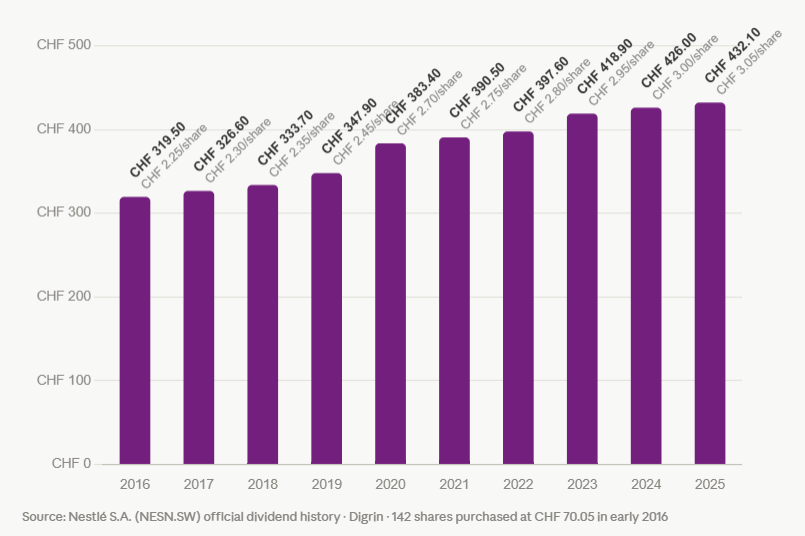
Every April without you doing anything Nestlé deposited a cash dividend directly into your brokerage account. Just for owning the shares. What you did with that cash was your choice: spend it, save it, or reinvest it back into more Nestlé shares. In this example, the investor simply took the cash.
Over 10 years, those 142 shares paid out CHF 3,776 in dividend income without selling a single share. The dividend grew every single year, from CHF 2.25 to CHF 3.05 per share. That's not a projection. That's what happened.
Had those dividends been reinvested each year to buy more shares, the total would have been even higher because each year you'd own slightly more shares than the year before, and each year's dividend would be calculated on a larger base.
And this is all before counting any growth in the share price itself.
Source: Nestlé S.A. (NESN.SW) official dividend history via Digrin
Pros and Cons of Investing in Dividend Stocks
The Bottom Line
Dividends are one of the oldest wealth-building tools in existence. For generations, they quietly built fortunes for the people who understood them and were invisible to everyone else.
Now you understand them.
You don't need a billion-dollar portfolio to start. You need a share, a brokerage account, and a strategy that works for your life. That's where it begins.
And if you want to keep building that knowledge, one month at a time, we bring you real market updates and financial clarity, straight to your inbox. Just what you actually need to know.

Click here to subscribe for FREE: https://herfinancialfreedom.net/newsletter-blog
Sources
https://www.investopedia.com/terms/d/dividend.asp
https://www.moneythumb.com/blog/a-beginners-guide-to-dividends-and-how-they-work/
https://www.munich-business-school.de/en/l/business-studies-dictionary/financial-knowledge/dividend
https://www.td.com/ca/en/investing/direct-investing/articles/dividend-stocks


