Saving vs. Investing: What's the Difference — And Why It Matters More Than You Think
Let me tell you something that took me years working in wealth management to fully appreciate.
Most women I meet are excellent savers.
They have money set aside. They don't overspend. They're careful, responsible, and thoughtful about their finances. And yet — they're quietly falling behind.
Not because they're doing anything wrong. But because saving and investing are not the same thing. And no one ever told them the difference.
First: You Were Taught to Save. Not to Invest.
Think back to how you learned about money as a girl.
You got a piggy bank. You were told to "put something away for a rainy day." Maybe your parents rewarded you for not spending your birthday money. The lesson was always the same: be careful, be cautious, hold onto what you have.
Boys, meanwhile, were often encouraged to take risks. To make money work for them. To think about returns.
This isn't a coincidence. It's a pattern and it has a direct impact on the gender wealth gap we see today. According to the Swiss Federal Statistical Office, women in Switzerland receive on average 34.6% less in pension income than men, a difference of CHF 18,924 every single year in retirement.
The first step to closing that gap? Understanding what saving actually does, and what it doesn't.
What Is Saving?
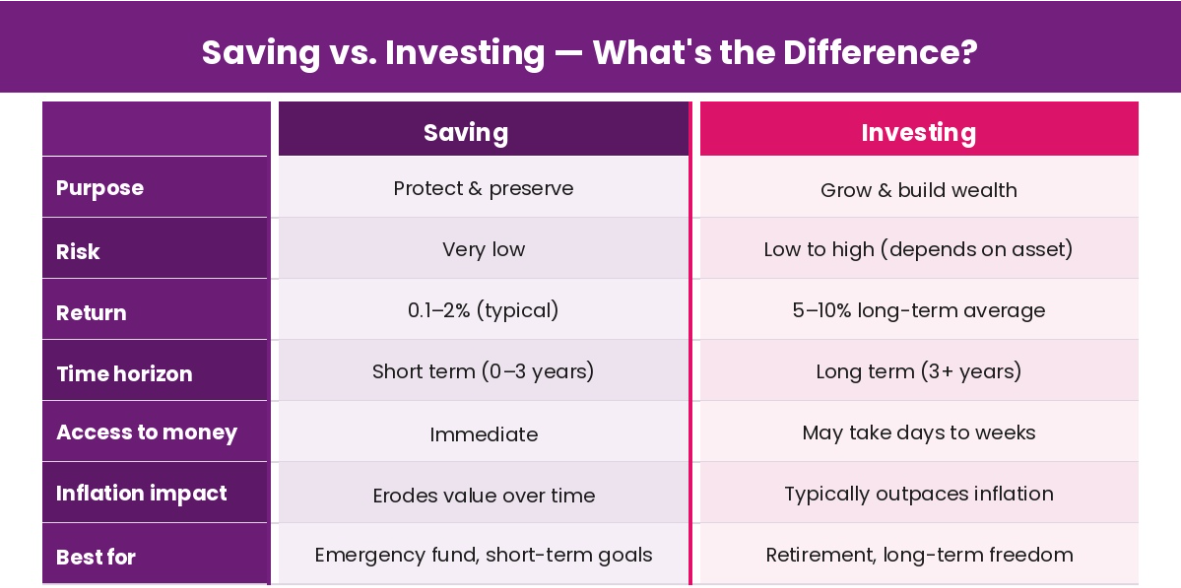
Saving means putting money aside in a safe, accessible place, usually a bank account for future use.
It's protective. It's liquid (meaning you can access it quickly). And it's essential especially as your emergency cushion.
When saving makes sense:
Building your emergency fund (3–6 months of living expenses)
Saving for a short-term goal: a trip, a new laptop, a deposit on a flat
Holding money you'll need within the next 1–3 years
The honest downside: Your money in a savings account is safe but it's standing still. With inflation running at 2–3% per year, the purchasing power of that money is actually shrinking. EUR 10,000 sitting in a 0.1% savings account today will buy you less in five years than it does today.
Saving is a shelter. It's not a growth strategy.
What Is Investing?
Investing means putting your money into assets like stocks, ETFs, funds, bonds, real estate with the expectation that it will grow in value over time.
It comes with more risk than saving. Markets go up and down. There are no guarantees. But over the long term and this is backed by over a century of market data, a diversified portfolio has consistently outperformed cash.
When investing makes sense:
Money you won't need for at least 3–5 years (ideally longer)
Building long-term wealth: retirement, financial independence, generational wealth
Making your money work while you sleep
The honest truth: Most women who come to me aren't nervous about the concept of investing. They're nervous about doing it wrong. They hold off until they "know more," until the timing feels right, until they have "enough."
And in the meantime? Their money sits in cash. And the gap grows.
Saving Is Not Enough — Here's the Proof
Meet Anna and Sophie.
Both 35. Both earn EUR 3,500/month after tax. Both save diligently.
Anna puts her EUR 500 into a savings account. It feels safe and it is. But at 0.5% interest a year, after 30 years she has built up roughly EUR 193,000. Not nothing. But not freedom either.
Sophie puts her EUR 500 into a diversified ETF portfolio. She doesn't check it every day. She doesn't try to time the market. She just leaves it there, growing at an average of 7% a year. After 30 years? She has roughly EUR 567,000.
The gap between them is EUR 374,000.
Not because Sophie earned more. Not because she worked harder or spent less. She made one different decision — where to put the money she was already setting aside.
The Key Differences at a Glance
"But Isn't Investing Risky?"
Yes. And so is doing nothing.
I know that sounds blunt — but I've sat across from too many women in their 50s who did everything "right" (saved diligently, spent carefully, worked hard) and still found themselves unprepared for retirement. Not because they failed. Because no one told them the cost of keeping everything in cash.
The risk of investing is visible. You can see a market dip. You can feel it.
The risk of not investing is invisible. It happens slowly, silently, over decades. By the time you notice it, the compound growth window has closed.
Here's what helps: a diversified, long-term investment approach is far less volatile than people think. A simple global ETF — which spreads your money across hundreds of companies in one purchase — has historically recovered from every downturn and continued growing. You don't need to pick stocks. You don't need to watch charts. You need time and consistency.
So What Should You Do With Your Money?
Here's the simple framework I share with every woman I work with:
Step 1 — Build your safety net first Before you invest a single euro, make sure you have 3–6 months of essential expenses in a liquid savings account. This is your emergency fund. It means you'll never have to sell your investments at the wrong time because something unexpected came up.
Step 2 — Invest everything above that Once your emergency fund is in place, every euro you save beyond your short-term needs should be working for you — in a diversified, low-cost investment portfolio. Not sitting idle. Not waiting for the "right moment." Growing.
Step 3 — Keep it simple You don't need a complex portfolio. A global index fund or ETF gives you instant diversification, low fees, and access to the long-term growth of the global economy. Start there.
Step 4 — Automate and forget Set up a monthly transfer from your salary to your investment account. Same day. Same amount. And then let it compound. The less you tinker, the better the outcome.
The Numbers That Change Everything
I want to leave you with this.
If you invest EUR 270/month starting at age 35 — that's less than EUR 10 a day — at a 7% average annual return, here's what happens:
After 10 years: EUR 46,000
After 20 years: EUR 139,000
After 30 years: EUR 340,000
You didn't get a raise. You didn't win anything. You just started — and stayed consistent.
Now imagine you wait until 45 to start. That same EUR 270/month, for 20 years instead of 30, gives you EUR 139,000 instead of EUR 340,000.
The decade you waited cost you EUR 201,000.
That is the price of waiting.
You Don't Need to Be an Expert. You Need to Start.
I spent 15 years managing billions for other people. And when I had to manage my own money for the first time — really manage it, with intention and strategy — I froze.
If it can happen to me, it can happen to anyone.
The difference between the women I see building real wealth and the ones still sitting on the sidelines isn't intelligence. It isn't income. It's one decision: to start.
You don't need to understand every financial instrument. You don't need to read the FT every morning. You don't need to wait until you feel confident — because that day comes after you start, not before.
Start with your emergency fund. Then invest the rest. Automate it. And let time do the work.
That's it. That's the whole secret.


